1p36 deletion syndrome
46,XX,del(1)(p36.3)
Also known as: 1p36 minus, monosomy 1p36
46,XX,del(1)(p36.3) is the karyotype of 1p36 deletion syndrome, the most common terminal deletion syndrome in humans. It is a loss of the tip of the short arm of chromosome 1.
Open in the interactive visualizer →
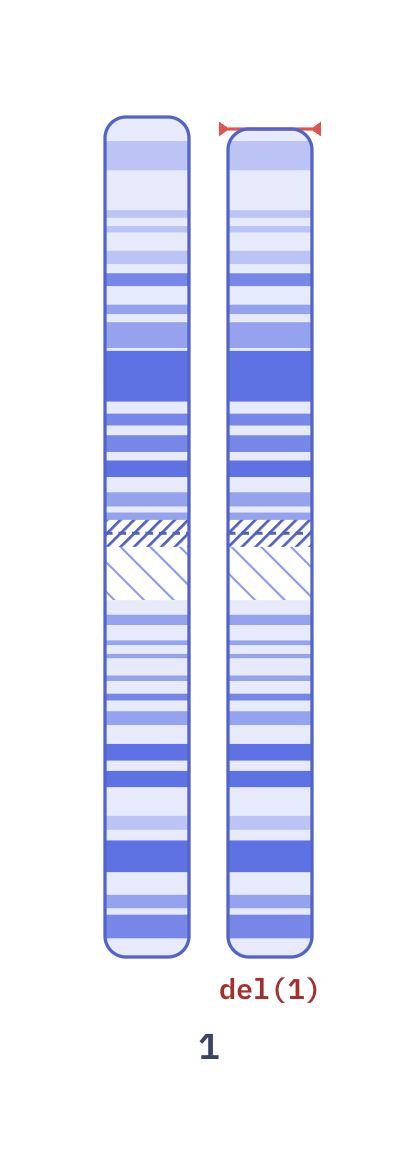
What banding sees: Most 1p36 deletions are too small to see with banding, so the diagnosis is usually made by microarray or FISH rather than by a karyotype. The drawing above shows where the missing segment lies, not what would be visible down a microscope.
What the notation means
The shape of this abnormality
- (1)
- one chromosome, so one group of breakpoints follows.
- (p36.3)
- one band: everything from it out to the tip is lost (a terminal deletion).
- count · sex chromosomes
- a normal count and the usual female sex chromosomes
- abnormality
- a terminal DELETION of chromosome 1: everything distal to 1p36.3 (out to the tip) is lost
Clinical notes
del(1)(p36), 1p36 deletion syndrome
This is the most common terminal deletion syndrome: hypotonia, developmental disability, seizures, straight eyebrows and a deep-set look, often submicroscopic and made by microarray rather than banding. The same region is lost somatically in neuroblastoma, where 1p deletion is an adverse marker that travels with MYCN amplification, one address with a constitutional and an acquired story.