Ring chromosome 13
46,XY,r(13)(p11q34)
Also known as: r(13), ring 13
46,XY,r(13)(p11q34) is a ring chromosome 13, formed when both arms of chromosome 13 break and the broken ends fuse into a circle. Ring chromosomes are unstable through cell division.
Open in the interactive visualizer →
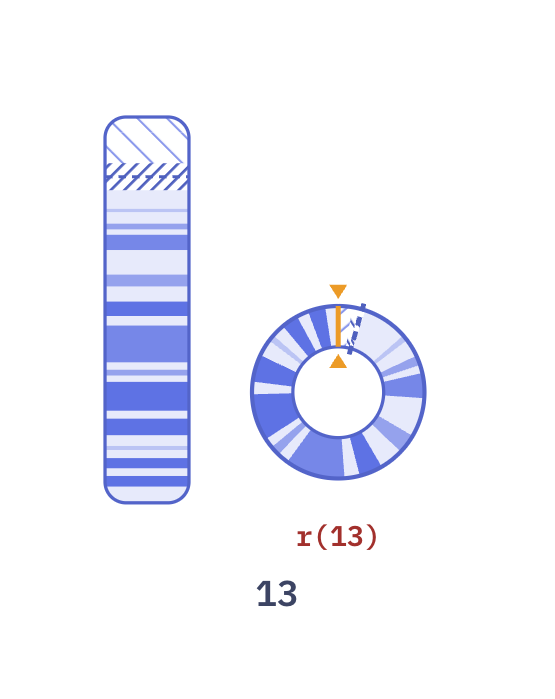
What the notation means
46 is the number of chromosomes counted in the cell. That is the normal number: 22 pairs of autosomes, the chromosomes other than X and Y, plus one pair of sex chromosomes. XY lists the sex chromosomes, here one X and one Y, the usual male set. These two fields open every karyotype because they describe the whole cell. Any abnormality is written after them.
A RING chromosome (r): both arms break and the broken ends fuse into a circle, usually losing the distal tips. (13) refers to chromosome 13, the chromosome that closed into a ring. One chromosome is listed, so one group of breakpoints follows, because each chromosome listed gets a group of its own. (p11q34) gives the two breakpoints, 13p11 and 13q34, where the ends joined to close the ring. The tips beyond them are lost.