Isochromosome Xq
46,X,i(X)(q10)
Also known as: i(Xq), isochromosome X
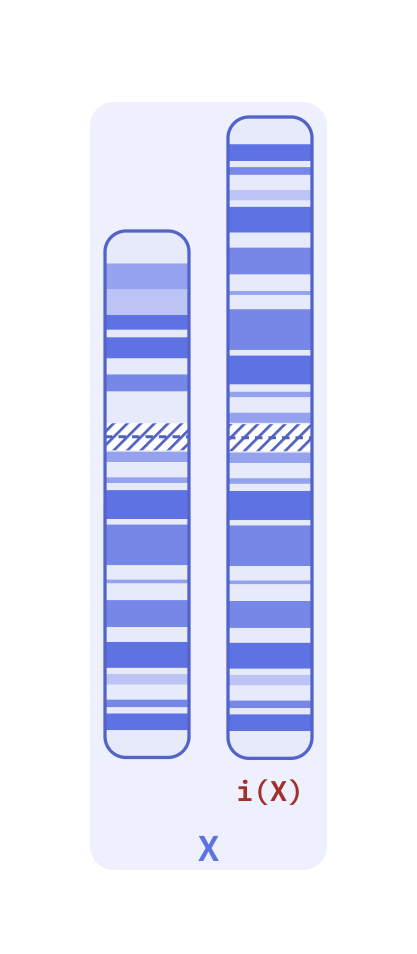
46,X,i(X)(q10) pairs one normal X with an isochromosome of the X long arm, so the short arm of the X is present in only one copy. It is a recurrent structural cause of Turner syndrome.
Open in the interactive visualizer →
What the notation means
46count,Xsex chromosomes,i(X)(q10)abnormality
The shape of this abnormality
isymbol(X)chromosomes(q10)breakpoints
- (X)
- one chromosome, so one group of breakpoints follows.
- (q10)
- p10 or q10 names the arm that is doubled; the other arm is lost.
- count
- total chromosome count (normal = 46)
- sex chromosomes
- sex chromosomes: one X, listed alone because the other X is named in the rearrangement below. This is not monosomy X
- abnormality
- an ISOCHROMOSOME i(X): a mirror-image chromosome made of two long (q) arms, so the short (p) arm is lost; this cell line ends up with three copies of Xq and one copy of Xp. Written i because both arms are copies of the SAME arm, a true mirror and genetically homozygous; when that identity is not proven, ISCN writes der(X;X)(q10;q10) instead. Expected X inactivation is skewed: the structurally abnormal X is silenced and the normal X stays active, the pattern that leaves the least functional imbalance. That depends on the abnormal X keeping its X-inactivation center at Xq13
Clinical notes
Turner syndrome (45,X and variants)
Loss of all or part of the second sex chromosome. 45,X (monosomy X) is classic; variants include an isochromosome i(Xq), a ring r(X), an SRY-negative rearranged Y, and 45,X mosaicism (e.g. 45,X/46,XX, or with an unstable idic(Y) line). Short stature, ovarian dysgenesis/streak gonads, webbed neck, coarctation/bicuspid aortic valve, lymphedema.