Chromosome 1q duplication
46,XY,dup(1)(q22q25)
Also known as: partial trisomy 1q, dup(1q)
46,XY,dup(1)(q22q25) shows a duplication on the long arm of chromosome 1, so that segment is present in three copies (a partial trisomy). Duplications add genetic material without losing any.
Open in the interactive visualizer →
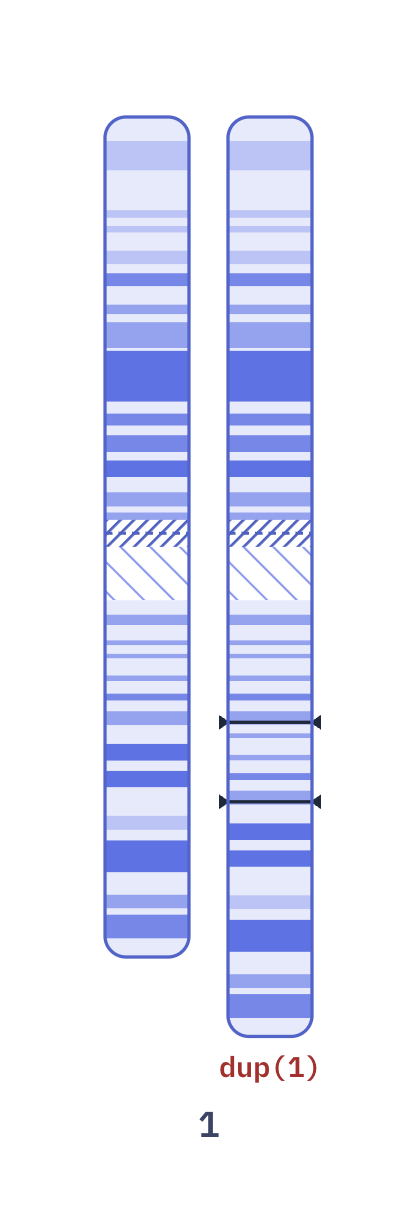
What the notation means
46 is the number of chromosomes counted in the cell. That is the normal number: 22 pairs of autosomes, the chromosomes other than X and Y, plus one pair of sex chromosomes. XY lists the sex chromosomes, here one X and one Y, the usual male set. These two fields open every karyotype because they describe the whole cell. Any abnormality is written after them.
A DUPLICATION (dup): a segment present twice on the same chromosome. (1) refers to chromosome 1, the chromosome that carries the extra copy. One chromosome is listed, so one group of breakpoints follows, because each chromosome listed gets a group of its own. (q22q25) gives the two breakpoints that mark off the segment present twice, 1q22 and 1q25. They are written in the order they sit on the chromosome, from the tip of the short arm toward the tip of the long arm, which means the extra copy sits the same way round as the original. Written q25q22, the extra copy would be inverted.