Jacobsen syndrome
46,XY,del(11)(q24.1)
Also known as: 11q deletion, 11q terminal deletion
46,XY,del(11)(q24.1) is the karyotype of Jacobsen syndrome, a terminal deletion of the long arm of chromosome 11. It is associated with a bleeding disorder (Paris-Trousseau thrombocytopenia), heart defects, and developmental delay.
Open in the interactive visualizer →
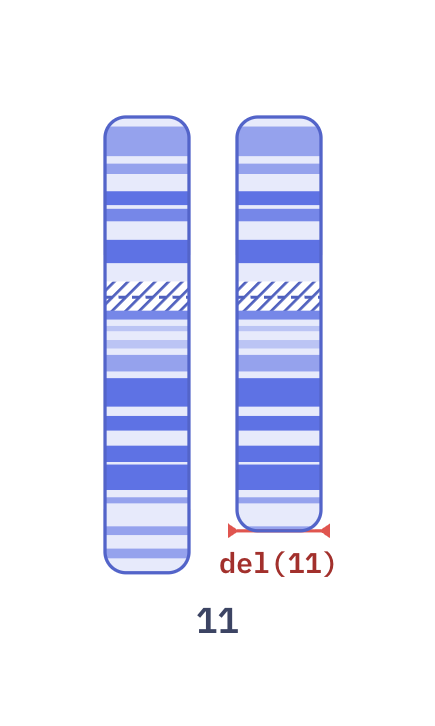
What the notation means
46 is the number of chromosomes counted in the cell. That is the normal number: 22 pairs of autosomes, the chromosomes other than X and Y, plus one pair of sex chromosomes. XY lists the sex chromosomes, here one X and one Y, the usual male set. These two fields open every karyotype because they describe the whole cell. Any abnormality is written after them.
A DELETION (del): a segment is missing. (11) refers to chromosome 11, the chromosome that loses a segment. One chromosome is listed, so one group of breakpoints follows, because each chromosome listed gets a group of its own. (q24.1) gives one breakpoint, 11q24.1. With one breakpoint, everything from that band out to the tip of the long arm is lost. That is called a terminal deletion. To lose only a piece inside that band, the band is written twice, del(11)(q24.1q24.1), because a piece with chromosome on both sides of it needs a breakpoint at each side.
Clinical notes
del(11)(q23-q24), Jacobsen syndrome
This terminal deletion of distal 11q means Jacobsen syndrome: growth and developmental delay, characteristic facies, and the Paris-Trousseau platelet disorder from FLI1 loss, so a bleeding history belongs in the workup. Most cases arise de novo; a parental balanced rearrangement is the heritable minority worth excluding. The same FLI1, translocated rather than deleted, is the Ewing sarcoma partner.