Isodicentric Y chromosome
46,X,idic(Y)(q11.2)
Also known as: idic(Y), isodicentric Yq11.2, dicentric Y
46,X,idic(Y)(q11.2) is an isodicentric Y, the most common structural abnormality of the Y chromosome: a mirror-image chromosome with two centromeres, formed by breakage and fusion within Yq11.2. Dicentrics are mitotically unstable, so idic(Y) is usually found in mosaic with a 45,X cell line, and the phenotype ranges from Turner syndrome to a male with infertility.
Open in the interactive visualizer →
What the notation means
The shape of this abnormality
- (Y)
- one chromosome, so one group of breakpoints follows.
- (q11.2)
- one band: where the two sister copies joined, so the mirror carries two centromeres.
- count
- total chromosome count (normal = 46)
- sex chromosomes
- sex chromosomes: one X, listed alone because the Y is named in the rearrangement below. This is not monosomy X
- abnormality
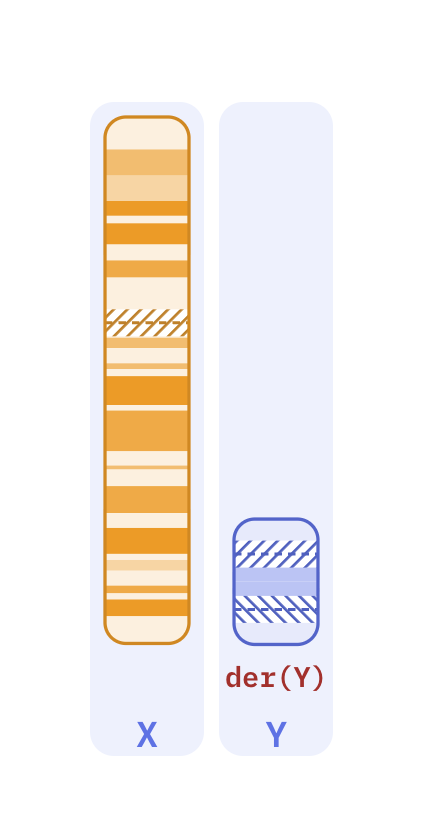
- an ISODICENTRIC chromosome idic(Y): chromosome Y breaks at Yq11.2. What survives a break is the piece carrying the centromere, since a fragment without one cannot hold onto the spindle at cell division, so the piece kept here is Ypter→Yq11.2, joined to a second copy of itself. The two copies meet at the breakpoint as mirror images rather than one behind the other, so each brings its own centromere. It replaces one copy of chromosome Y, trading everything past the break, Yq11.2→Yqter, for a second copy of Ypter→Yq11.2. Drawn to scale it comes to about 37 Mb, about two-thirds the length of the normal Y it replaces (57 Mb). Why idic and not dic(Y;Y)? idic asserts ONE chromosome of origin: a single break, sister chromatids reunited into the mirror. dic(Y;Y) would mean the two homologues each broke and fused into it, standing in place of both. And why not i(Y)? An isochromosome mirrors about the centromere itself (breakpoint p10 or q10) and carries one centromere; this mirror breaks out on the arm, so both centromeres ride along, one usually inactivated.
Clinical notes
Rearranged Y with SRY retained
This dicentric or ring Y keeps SRY, so development is usually male, and this is not Turner syndrome by itself. Chromosomes with two centromeres or a ring shape are mitotically unstable, and a line that has lost the abnormal Y, classically 45,X, is often present or arises; the phenotype follows the mosaic, from a Turner-like female through mixed gonadal dysgenesis to an infertile male. Finding one in a single sample is a reason to look for 45,X mosaicism, and Y material beside a 45,X line carries a gonadoblastoma risk.