5q minus syndrome (MDS)
46,XX,del(5)(q13q33)
Also known as: del(5q), 5q- syndrome
46,XX,del(5)(q13q33) is an interstitial deletion of the long arm of chromosome 5, the defining lesion of the 5q minus subtype of myelodysplastic syndrome. It responds well to lenalidomide and generally has a favorable course.
Open in the interactive visualizer →
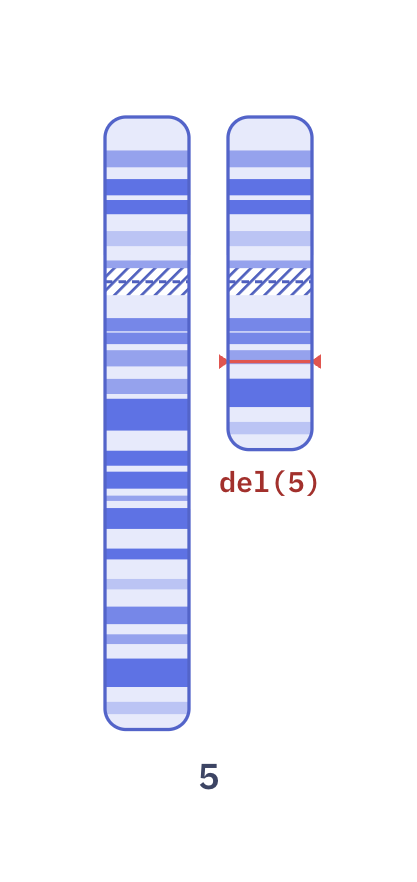
What the notation means
46 is the number of chromosomes counted in the cell. That is the normal number: 22 pairs of autosomes, the chromosomes other than X and Y, plus one pair of sex chromosomes. XX lists the sex chromosomes, here two X chromosomes, the usual female set. These two fields open every karyotype because they describe the whole cell. Any abnormality is written after them.
A DELETION (del): a segment is missing. (5) refers to chromosome 5, the chromosome that loses a segment. One chromosome is listed, so one group of breakpoints follows, because each chromosome listed gets a group of its own. (q13q33) gives two breakpoints, 5q13 and 5q33, listed in the order they sit on the chromosome, from the tip of the short arm toward the tip of the long arm. The segment between them is lost and the two ends rejoin. That is an interstitial deletion.
Clinical notes
del(5q), MDS with isolated del(5q)
The one marrow karyotype with its own drug: myelodysplastic syndrome with isolated del(5q) causes anemia with a normal or raised platelet count and hypolobated megakaryocytes, and it responds to lenalidomide. The mechanism is haploinsufficiency, RPS14 for the anemia and CSNK1A1 for the lenalidomide response, with no second hit needed. A co-occurring TP53 mutation predicts lenalidomide failure and transformation, so it is worth looking for at diagnosis. Matched only as an interstitial q-arm deletion, so the constitutional 5q35 deletion of Sotos syndrome never collects this note.