AML with t(8;21)
46,XX,t(8;21)(q22;q22)
Also known as: RUNX1-RUNX1T1, AML1-ETO, t(8;21)
46,XX,t(8;21)(q22;q22) is a recurrent translocation in acute myeloid leukemia that fuses RUNX1 with RUNX1T1. It is one of the core-binding-factor leukemias and generally carries a favorable prognosis.
Open in the interactive visualizer →
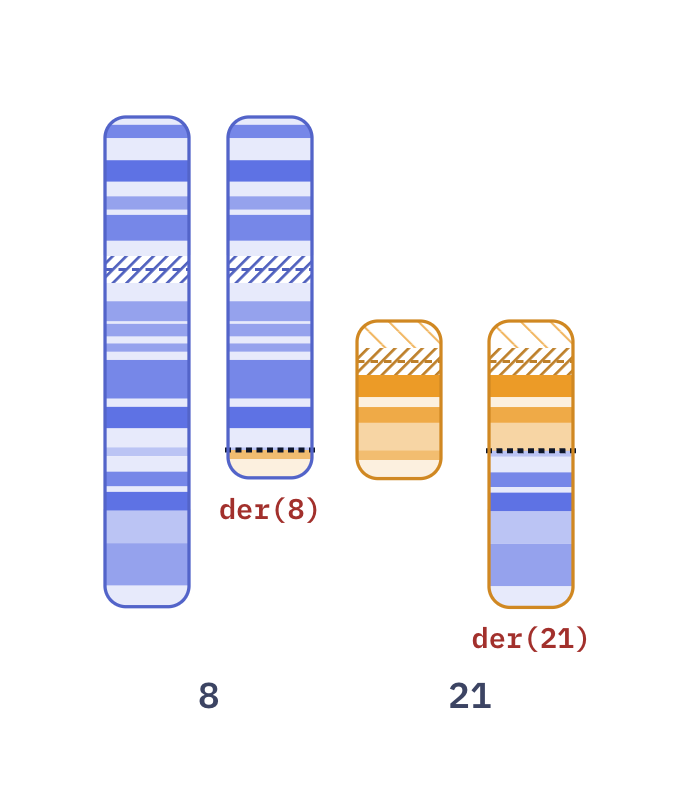
What the notation means
The shape of this abnormality
- (8;21)
- the two chromosomes, the sex chromosome or the lower number first.
- (q22;q22)
- one breakpoint on each chromosome, in the same order; each keeps its own centromere and takes the other's piece beyond the break.
- count · sex chromosomes
- a normal count and the usual female sex chromosomes
- abnormality
- a reciprocal TRANSLOCATION: chromosomes 8 and 21 break (at 8q22 and 21q22) and swap the pieces beyond those breaks, giving two derivative chromosomes der(8) and der(21). The pieces that move are the tips, which carry no centromere; each derivative keeps the centromere it started with, and that is the chromosome it is named for
Clinical notes
t(8;21), core-binding-factor AML
RUNX1::RUNX1T1. WHO defines an AML by this translocation, whatever the blast count, and it sits in the favorable-risk group. It is one of the two core-binding-factor leukemias: RUNX1 is the alpha subunit of that transcription factor and CBFB the beta, which is why this lesion and inv(16) share one risk category and one treatment path, high-dose cytarabine consolidation. Auer rods and a maturing myeloid picture are the classic morphology. A co-occurring KIT mutation worsens the outlook, so it is worth sending the molecular panel.