Acute promyelocytic leukemia t(15;17)
46,XY,t(15;17)(q24;q21)
Also known as: APL, PML-RARA, t(15;17)
46,XY,t(15;17)(q24;q21) is the defining translocation of acute promyelocytic leukemia (APL), fusing PML on chromosome 15 with RARA on chromosome 17. The fusion makes APL uniquely responsive to all-trans retinoic acid, so recognizing it changes treatment.
Open in the interactive visualizer →
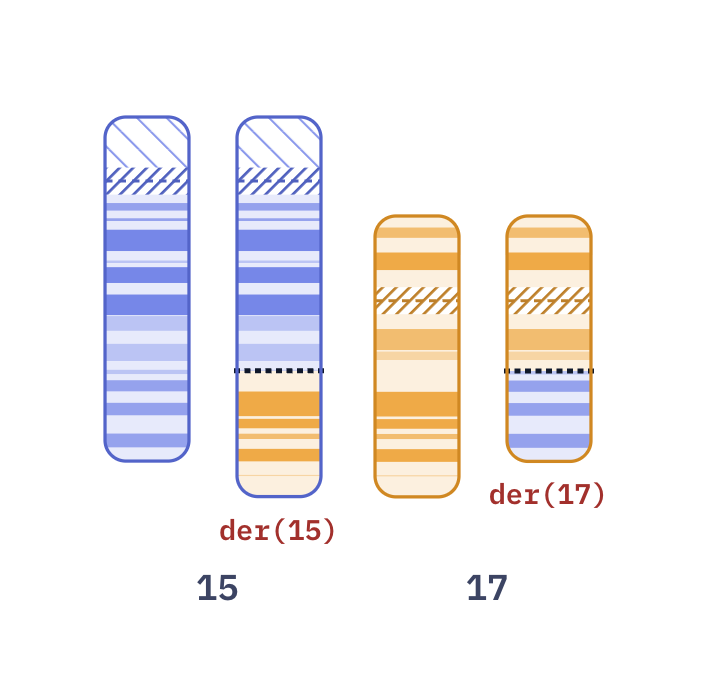
What the notation means
The shape of this abnormality
- (15;17)
- the two chromosomes, the sex chromosome or the lower number first.
- (q24;q21)
- one breakpoint on each chromosome, in the same order; each keeps its own centromere and takes the other's piece beyond the break.
- count · sex chromosomes
- a normal count and the usual male sex chromosomes
- abnormality
- a reciprocal TRANSLOCATION: chromosomes 15 and 17 break (at 15q24 and 17q21) and swap the pieces beyond those breaks, giving two derivative chromosomes der(15) and der(17). The pieces that move are the tips, which carry no centromere; each derivative keeps the centromere it started with, and that is the chromosome it is named for
Clinical notes
t(15;17), acute promyelocytic leukemia
PML::RARA. This karyotype is a medical emergency before it is a diagnosis: it means acute promyelocytic leukemia, which kills by disseminated intravascular coagulation in days, so all-trans retinoic acid is started on morphological suspicion rather than held for confirmation. With ATRA and arsenic trioxide the disease is now among the most curable acute leukemias. Differentiation syndrome is the treatment complication to expect.