Philadelphia chromosome
46,XY,t(9;22)(q34;q11.2)
Also known as: t(9;22), BCR-ABL1, CML
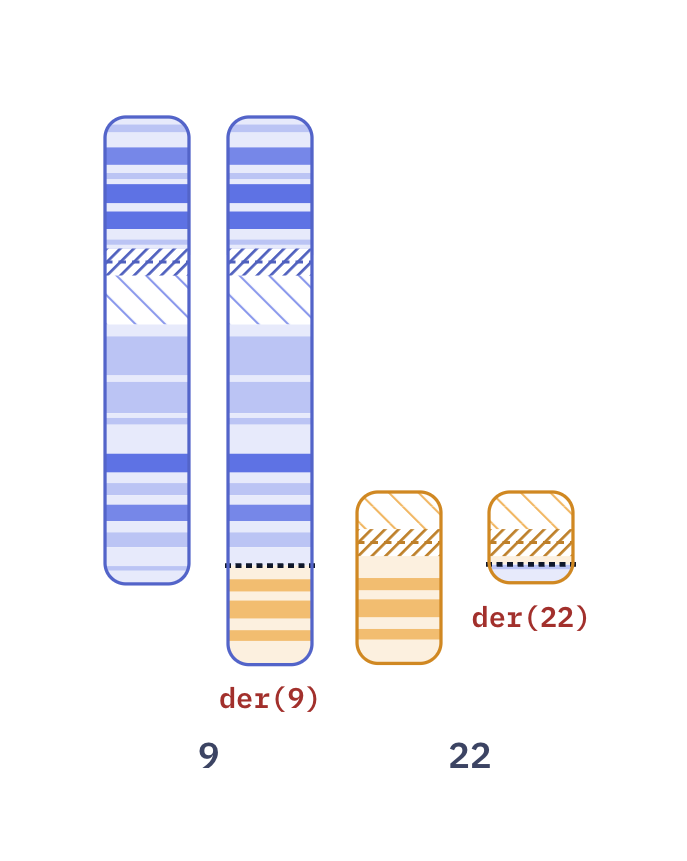
46,XY,t(9;22)(q34;q11.2) is the Philadelphia chromosome, a reciprocal translocation between chromosomes 9 and 22. The resulting BCR::ABL1 fusion gene defines chronic myeloid leukemia.
Open in the interactive visualizer →
What the notation means
The shape of this abnormality
- (9;22)
- the two chromosomes, the sex chromosome or the lower number first.
- (q34;q11.2)
- one breakpoint on each chromosome, in the same order; each keeps its own centromere and takes the other's piece beyond the break.
- count · sex chromosomes
- a normal count and the usual male sex chromosomes
- abnormality
- a reciprocal TRANSLOCATION: chromosomes 9 and 22 break (at 9q34 and 22q11.2) and swap the pieces beyond those breaks, giving two derivative chromosomes der(9) and der(22). The pieces that move are the tips, which carry no centromere; each derivative keeps the centromere it started with, and that is the chromosome it is named for
Clinical notes
t(9;22), Philadelphia chromosome
BCR::ABL1. In a marrow karyotype this translocation is chronic myeloid leukemia until proven otherwise, and the same fusion defines Philadelphia-positive ALL and a rare AML, so the blood picture around it decides the disease. It is the rearrangement that made targeted therapy a category: imatinib and the tyrosine-kinase inhibitors after it bind the constitutively active ABL1 kinase, and a disease that once meant transplant is now managed on tablets. In ALL it is a poor-risk marker that adds a TKI to chemotherapy. The 190 kDa product typical of ALL and the 210 kDa product typical of CML come from different breakpoints within BCR, which banding cannot separate, so PCR still has a job.