Burkitt lymphoma t(8;14)
46,XX,t(8;14)(q24;q32)
Also known as: MYC-IGH, t(8;14)
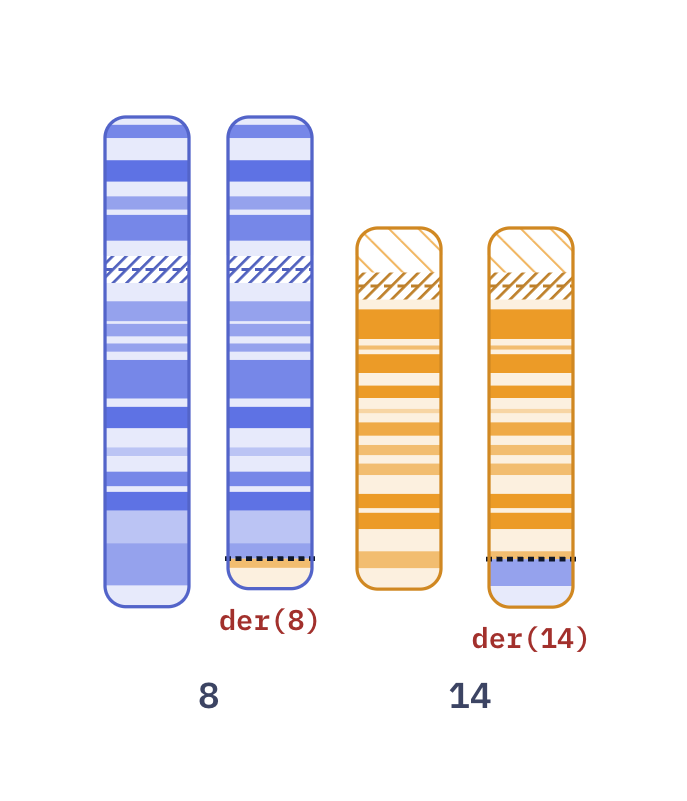
46,XX,t(8;14)(q24;q32) is the classic translocation of Burkitt lymphoma. It places the MYC oncogene on chromosome 8 next to the immunoglobulin heavy-chain locus IGH on chromosome 14, driving constant MYC expression.
Open in the interactive visualizer →
What the notation means
The shape of this abnormality
- (8;14)
- the two chromosomes, the sex chromosome or the lower number first.
- (q24;q32)
- one breakpoint on each chromosome, in the same order; each keeps its own centromere and takes the other's piece beyond the break.
- count · sex chromosomes
- a normal count and the usual female sex chromosomes
- abnormality
- a reciprocal TRANSLOCATION: chromosomes 8 and 14 break (at 8q24 and 14q32) and swap the pieces beyond those breaks, giving two derivative chromosomes der(8) and der(14). The pieces that move are the tips, which carry no centromere; each derivative keeps the centromere it started with, and that is the chromosome it is named for
Clinical notes
t(8;14), Burkitt lymphoma
IGH::MYC, a juxtaposition rather than a fusion protein. In the right clinical picture this translocation means Burkitt lymphoma or leukemia: MYC moves under the immunoglobulin heavy-chain enhancer and is overexpressed intact, and the light-chain variants t(2;8) and t(8;22) do the same with kappa and lambda. Expect starry-sky morphology, a proliferation fraction approaching one hundred per cent, and a real risk of tumour lysis the moment treatment starts. A MYC rearrangement alongside BCL2 or BCL6 is a high-grade lymphoma of a different category, not Burkitt.