Follicular lymphoma t(14;18)
46,XX,t(14;18)(q32;q21)
Also known as: IGH-BCL2, t(14;18)
46,XX,t(14;18)(q32;q21) is the hallmark of follicular lymphoma. It joins the immunoglobulin heavy-chain locus IGH to BCL2, so the cell overexpresses BCL2 and resists apoptosis.
Open in the interactive visualizer →
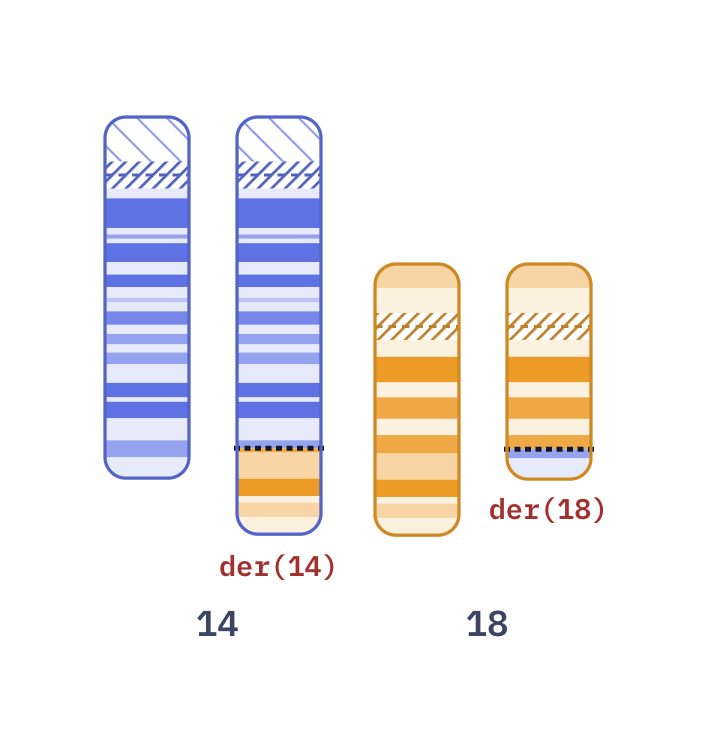
What the notation means
The shape of this abnormality
- (14;18)
- the two chromosomes, the sex chromosome or the lower number first.
- (q32;q21)
- one breakpoint on each chromosome, in the same order; each keeps its own centromere and takes the other's piece beyond the break.
- count · sex chromosomes
- a normal count and the usual female sex chromosomes
- abnormality
- a reciprocal TRANSLOCATION: chromosomes 14 and 18 break (at 14q32 and 18q21) and swap the pieces beyond those breaks, giving two derivative chromosomes der(14) and der(18). The pieces that move are the tips, which carry no centromere; each derivative keeps the centromere it started with, and that is the chromosome it is named for
Clinical notes
t(14;18), follicular lymphoma
IGH::BCL2, a juxtaposition rather than a fusion protein. This translocation is the hallmark of follicular lymphoma and also appears in a subset of diffuse large B-cell lymphoma. It is the founding example of an anti-apoptotic oncogene: BCL2 under the IGH enhancer stops the cell dying rather than making it divide. It is present in most follicular lymphoma yet detectable at low levels in healthy people, so it is necessary but not sufficient for the diagnosis. One ambiguity is worth knowing: MALT1 sits in the same 18q21 region as BCL2, so a MALT lymphoma with a MALT1 rearrangement can carry an identically written t(14;18)(q32;q21), and the histology decides which disease the karyotype belongs to.