AML with inv(16)
46,XY,inv(16)(p13q22)
Also known as: CBFB-MYH11, AML M4Eo, inv(16)
46,XY,inv(16)(p13q22) is a pericentric inversion of chromosome 16 that fuses CBFB with MYH11, seen in acute myeloid leukemia with abnormal eosinophils (M4Eo). Like t(8;21), it is a core-binding-factor leukemia with a favorable prognosis.
Open in the interactive visualizer →
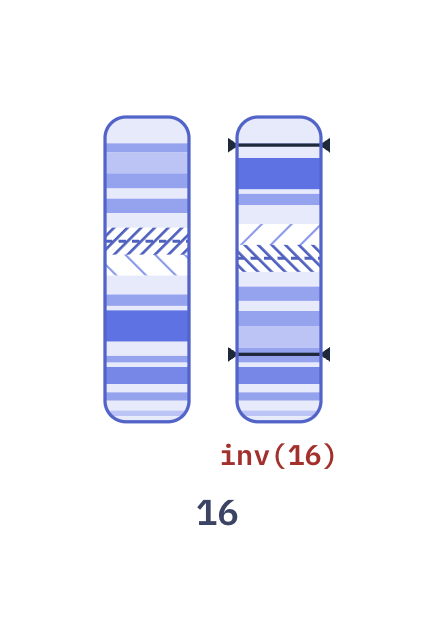
What the notation means
The shape of this abnormality
- (16)
- one chromosome, so one group of breakpoints follows.
- (p13q22)
- one band in each arm: the flipped segment spans the centromere (pericentric).
- count · sex chromosomes
- a normal count and the usual male sex chromosomes
- abnormality
- an INVERSION in chromosome 16: the segment between 16p13 and 16q22 is flipped end-for-end (pericentric, it spans the centromere)
Clinical notes
inv(16) / t(16;16), core-binding-factor AML
CBFB::MYH11. Two rearrangements, one disease: inv(16)(p13.1q22) and t(16;16)(p13.1;q22) both bring CBFB and MYH11 together, and WHO classifies either as the same favorable-risk AML, classically with abnormal marrow eosinophils. The inversion is far the commoner of the two. It is the other half of the core-binding-factor pair with t(8;21), sharing the cytarabine consolidation, and a KIT mutation again worsens it. Both breakpoints sit close to the centromere and the inversion is genuinely easy to miss on banding, so it is confirmed by FISH or RT-PCR rather than excluded by karyotype.