NUT carcinoma t(15;19)
46,XY,t(15;19)(q14;p13.1)
Also known as: BRD4-NUTM1, NUT midline carcinoma, t(15;19)
46,XY,t(15;19)(q14;p13.1) is the translocation of NUT carcinoma, fusing BRD4 with NUTM1. It defines an aggressive midline carcinoma of children and young adults, and it is one of the few carcinomas simple enough for the karyotype itself to be diagnostic.
Open in the interactive visualizer →
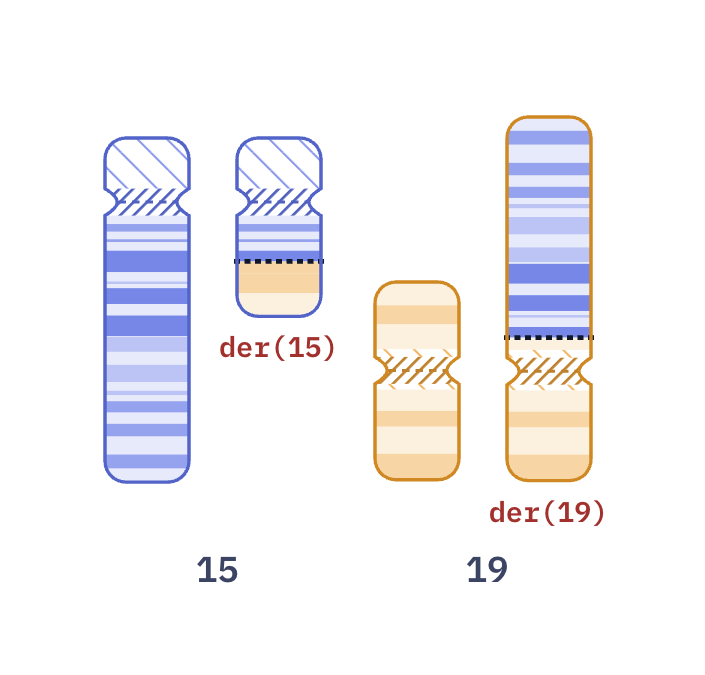
What the notation means
46- total chromosome count (the normal human number)
XY- sex chromosomes: one X, one Y (usual male karyotype)
t(15;19)(q14;p13.1)- a reciprocal TRANSLOCATION: chromosomes 15 and 19 break (at 15q14 and 19p13.1) and swap the pieces beyond those breaks, giving two derivative chromosomes der(15) and der(19). The pieces that move are the tips, which carry no centromere; each derivative keeps the centromere it started with, and that is the chromosome it is named for
Clinical notes
t(15;19), NUT carcinoma
BRD4::NUTM1. NUT carcinoma, a midline carcinoma of children and young adults. An undifferentiated carcinoma defined by a single rearrangement, which almost no other carcinoma is: solid tumours usually carry complex genomes, and this one is simple enough that its karyotype was diagnostic before its gene was known. Midline structures, head, neck and mediastinum, a rapid course, and median survival under a year. NUT immunohistochemistry is the practical test, and the BRD4 partner made it the proving ground for BET inhibitors.