Ewing sarcoma t(11;22)
46,XY,t(11;22)(q24;q12)
Also known as: EWSR1-FLI1, t(11;22), Ewing family tumor
46,XY,t(11;22)(q24;q12) is the defining translocation of Ewing sarcoma, fusing EWSR1 on chromosome 22 with FLI1 on chromosome 11. It accounts for most cases, and the fusion is what separates Ewing sarcoma from the other small round blue cell tumors of childhood.
Open in the interactive visualizer →
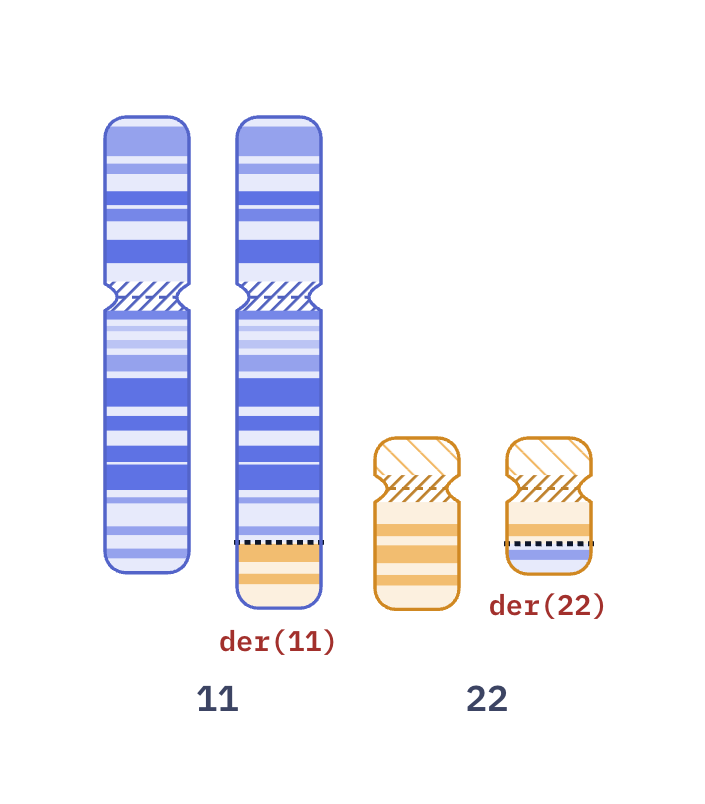
What the notation means
46 is the number of chromosomes counted in the cell. That is the normal number: 22 pairs of autosomes, the chromosomes other than X and Y, plus one pair of sex chromosomes. XY lists the sex chromosomes, here one X and one Y, the usual male set. These two fields open every karyotype because they describe the whole cell. Any abnormality is written after them.
A TRANSLOCATION (t): two chromosomes exchange segments. (11;22) lists the two chromosomes that exchanged segments, 11 and 22. The lower number is written first, or the sex chromosome if one is involved, so that the same translocation is always written the same way. (q24;q12) gives one breakpoint on each chromosome, in the same order as the chromosomes, so the breakpoints are 11q24 on 11 and 22q12 on 22. Each chromosome keeps its own centromere and takes the segment beyond the other's break.
Clinical notes
t(11;22), Ewing sarcoma
EWSR1::FLI1. In a small round blue cell tumour this translocation means Ewing sarcoma, where it accounts for about eighty-five per cent of cases; t(21;22), EWSR1::ERG, covers most of the rest. The fusion is what separates Ewing from lymphoblastic lymphoma and rhabdomyosarcoma, since membranous CD99 does not. An EWSR1 break-apart probe lights up across several unrelated sarcomas, so the partner matters.