Desmoplastic small round cell tumor t(11;22)
46,XX,t(11;22)(p13;q12)
Also known as: DSRCT, EWSR1-WT1, t(11;22)
46,XX,t(11;22)(p13;q12) is the translocation of desmoplastic small round cell tumor, fusing EWSR1 with WT1. It involves the same two chromosomes as Ewing sarcoma but a different arm of chromosome 11: q24 is Ewing, p13 is DSRCT, and the breakpoints are the only way to tell the two apart.
Open in the interactive visualizer →
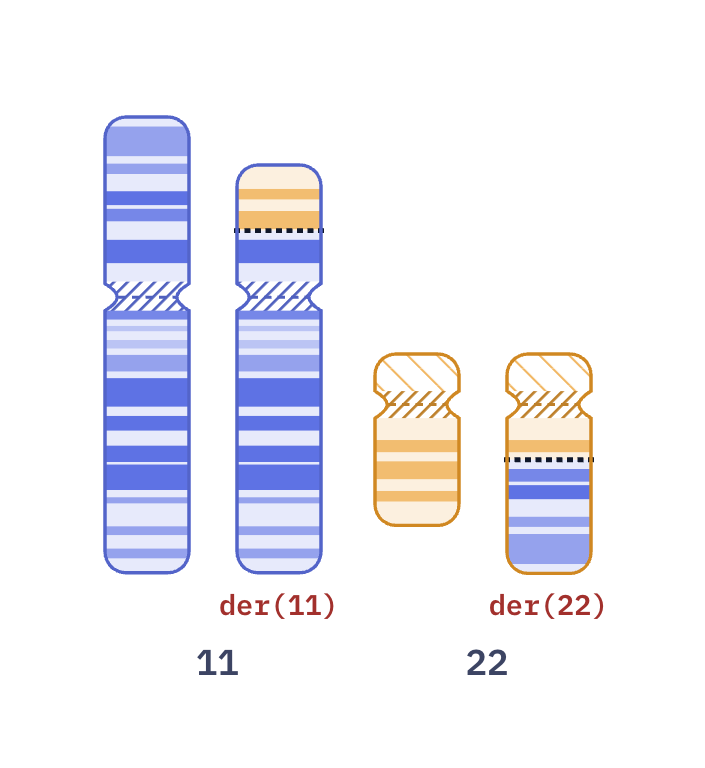
What the notation means
46- total chromosome count (the normal human number)
XX- sex chromosomes: two X (usual female karyotype)
t(11;22)(p13;q12)- a reciprocal TRANSLOCATION: chromosomes 11 and 22 break (at 11p13 and 22q12) and swap the pieces beyond those breaks, giving two derivative chromosomes der(11) and der(22). The pieces that move are the tips, which carry no centromere; each derivative keeps the centromere it started with, and that is the chromosome it is named for
Clinical notes
t(11;22)(p13;q12), desmoplastic small round cell tumour
EWSR1::WT1. Desmoplastic small round cell tumour. The same two chromosomes as Ewing sarcoma, a different arm of 11, and an unrelated disease: q24 is FLI1 and Ewing, p13 is WT1 and this. Adolescent and young adult males with widespread abdominal and pelvic disease, polyphenotypic by immunohistochemistry, and a poor outlook. The same WT1 carries germline mutations in WAGR and Denys-Drash syndromes; here it is broken somatically.