Robertsonian translocation 13;14
45,XX,rob(13;14)(q10;q10)
Also known as: rob(13;14), der(13;14)
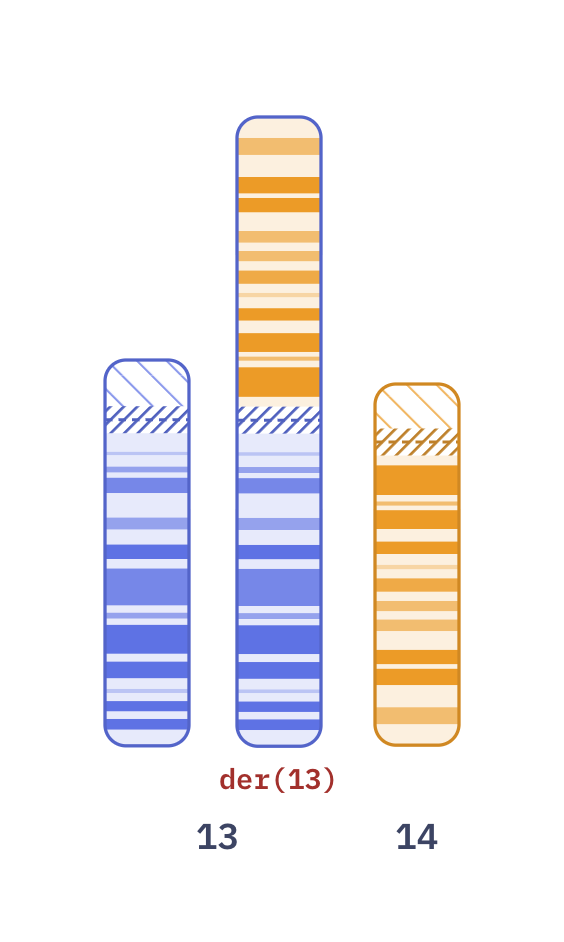
45,XX,rob(13;14)(q10;q10) is the most common Robertsonian translocation, a centromeric fusion of chromosomes 13 and 14 that lowers the chromosome count to 45. Carriers are healthy but face reproductive risks.
Open in the interactive visualizer →
What the notation means
45count,XXsex chromosomes,rob(13;14)(q10;q10)abnormality
The shape of this abnormality
robsymbol(13;14)chromosomes(q10;q10)breakpoints
- (13;14)
- the two acrocentric chromosomes fused at the centromere, the lower number first.
- (q10;q10)
- q10 and q10: the long arms joined at the centromere, the short arms lost.
- count
- total chromosome count (normal = 46)
- sex chromosomes
- sex chromosomes: two X (usual female karyotype)
- abnormality
- a ROBERTSONIAN translocation: the long arms of chromosomes 13 and 14 are fused at the centromere into one derivative chromosome, and the two short arms are lost. They are written lowest-number-first by convention, not by which centromere is kept; whole-arm fusions like this are usually dicentric, with one centromere inactivated. When a fusion is PROVEN dicentric it is written dic, with the breakpoints out in the short arms: dic(13;14)(p11.2;p11.2).