Translocation Down syndrome
46,XX,der(14;21)(q10;q10),+21
Also known as: translocation trisomy 21, der(14;21) trisomy 21, familial Down syndrome
46,XX,der(14;21)(q10;q10),+21 is Down syndrome caused by an unbalanced Robertsonian translocation: the count stays at 46, but the der(14;21) plus a free chromosome 21 add up to three copies of 21q. When a parent carries the balanced rob(14;21), the recurrence risk is far higher than after free trisomy 21, which is why the distinction matters for counseling.
Open in the interactive visualizer →
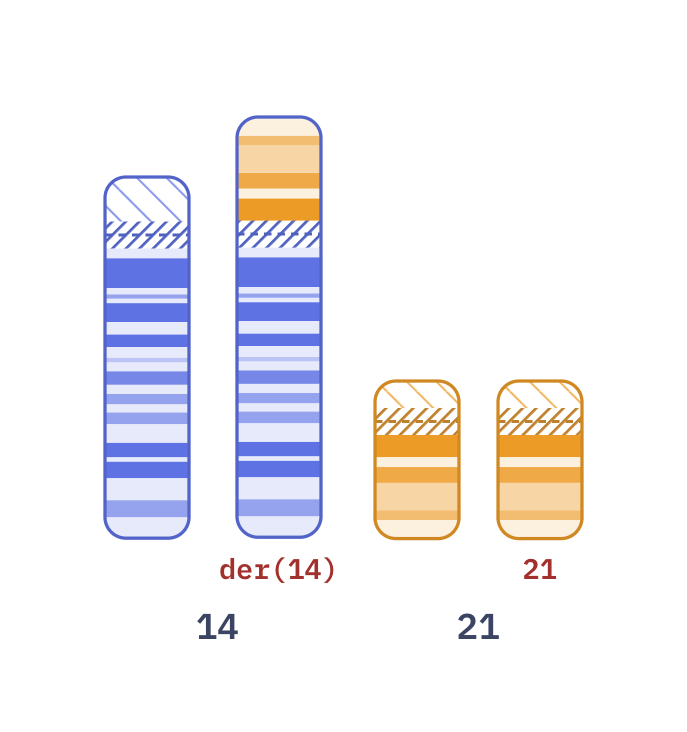
What the notation means
The shape of abnormality 1
- (14;21)
- the two chromosomes whose arms are joined at the centromere.
- (q10;q10)
- q10 and q10: the long arms joined at the centromere, the short arms lost.
- count · sex chromosomes
- a normal count and the usual female sex chromosomes
- abnormality 1
- a ROBERTSONIAN translocation: the long arms of chromosomes 14 and 21 are fused at the centromere into one derivative chromosome, and the two short arms are lost. They are written lowest-number-first by convention, not by which centromere is kept; whole-arm fusions like this are usually dicentric, with one centromere inactivated. When a fusion is PROVEN dicentric it is written dic, with the breakpoints out in the short arms: dic(14;21)(p11.2;p11.2). ISCN writes this either way, der(14;21)(q10;q10) or rob(14;21)(q10;q10), and prefers the der spelling
- abnormality 2
- an EXTRA copy of chromosome 21 (two copies in this cell line, with more 21 material on der(14;21))
Clinical notes
Trisomy 21, Down syndrome
The most common autosomal trisomy compatible with life (~1/700 births). Three copies of chromosome 21. Features: characteristic facies, hypotonia, intellectual disability, ~50% congenital heart disease (AV canal), ↑ risk of AML/ALL and early Alzheimer disease. ~95% free trisomy (nondisjunction, ↑ with maternal age), ~4% Robertsonian translocation, ~1% mosaic.