X-autosome translocation, manifesting female carrier
46,X,t(X;4)(p21;p16)
Also known as: t(X;4), X;autosome translocation, manifesting carrier, skewed X inactivation, Duchenne in a girl
46,X,t(X;4)(p21;p16) is balanced, yet the carrier is affected. In a balanced X-autosome carrier the normal X is the one silenced, because silencing the derivative would spread inactivation into the attached chromosome 4 material. That leaves the der(X) as her only active X, so the dystrophin gene broken at the Xp21 breakpoint has no working copy behind it, and she presents with a muscular dystrophy that is otherwise almost exclusive to boys. Translocations like this one are how several X-linked genes were first mapped.
Open in the interactive visualizer →
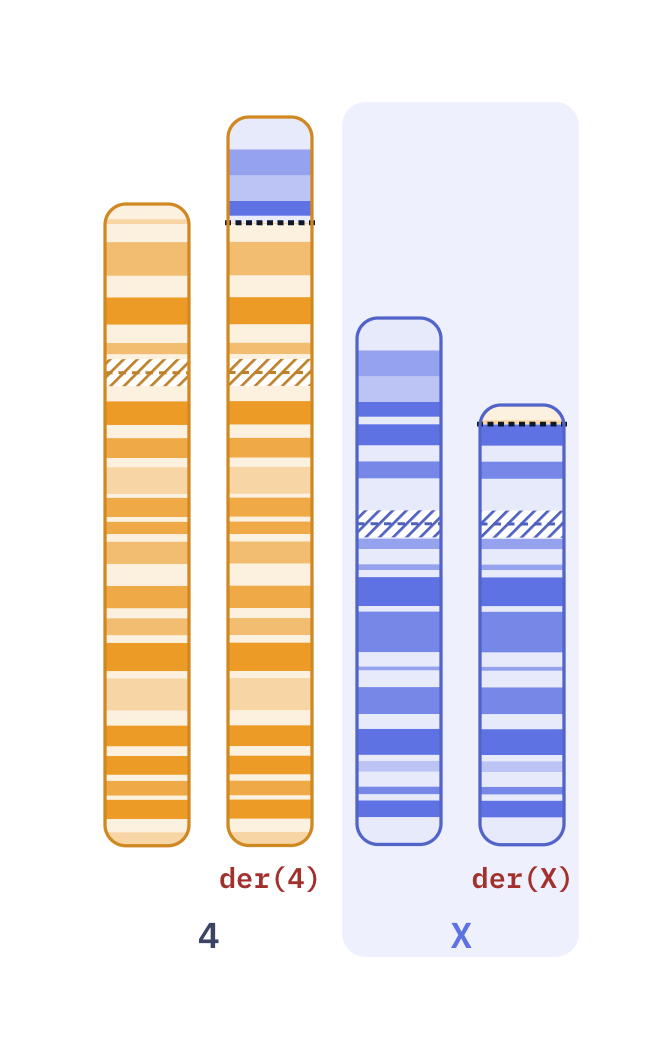
What the notation means
46count,Xsex chromosomes,t(X;4)(p21;p16)abnormality
The shape of this abnormality
tsymbol(X;4)chromosomes(p21;p16)breakpoints
- (X;4)
- the two chromosomes, the sex chromosome or the lower number first.
- (p21;p16)
- one breakpoint on each chromosome, in the same order; each keeps its own centromere and takes the other's piece beyond the break.
- count
- total chromosome count (normal = 46)
- sex chromosomes
- sex chromosomes: one X, listed alone because the other X is named in the rearrangement below. This is not monosomy X
- abnormality
- a reciprocal TRANSLOCATION: chromosomes X and 4 break (at Xp21 and 4p16) and swap the pieces beyond those breaks, giving two derivative chromosomes der(X) and der(4). The pieces that move are the tips, which carry no centromere; each derivative keeps the centromere it started with, and that is the chromosome it is named for. Expected X inactivation is skewed: the normal X is silenced, and both derivatives stay active. Silencing the der(X), which carries the center, would spread inactivation into the attached autosomal segment and leave it functionally monosomic, so those cells are selected against. Because the intact X is the silenced one, a gene disrupted at the X breakpoint is unmasked, and a balanced female carrier can still manifest an X-linked recessive disorder